Lagos
We are beginning with Lagos fleet and site development. There are no operating Cliff sites yet. The first projects remain dependent on fleet demand, power feasibility, property access and financing.

Deployment roadmap
We are starting where repeat vehicle demand, usable parking, electrical capacity and operating access can be established before broader public coverage is added. Lagos is our first deployment focus. Abuja and Port Harcourt are potential future markets, subject to fleet demand and proof from the first Lagos projects.
The sequence
We are not trying to colour a map with as many pins as possible. The first network has to work for the vehicles, properties and operating partners using it every day.
That means establishing sites around repeat demand, running those sites properly and only then widening access or adding corridor infrastructure where vehicle movement supports it.
Nigeria first
The map shows possible future markets, not operational locations, approved projects or a funded national rollout.
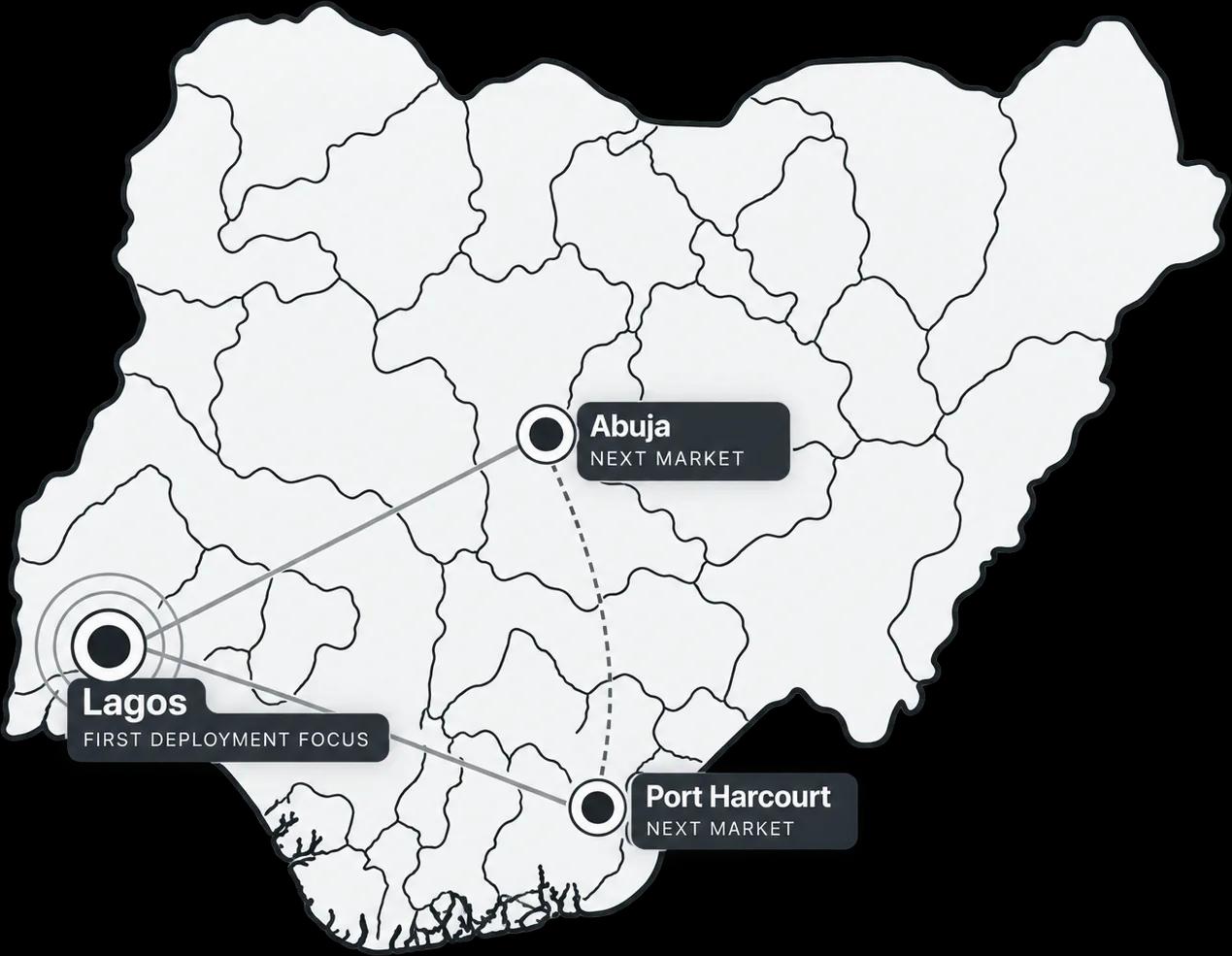
We are beginning with Lagos fleet and site development. There are no operating Cliff sites yet. The first projects remain dependent on fleet demand, power feasibility, property access and financing.
Abuja is a potential future market, subject to verifiable commercial demand, suitable sites and electrical capacity. Cliff has no approved construction there.
Port Harcourt may become relevant if fleet activity, site partnerships and power costs support a viable project. Any proposal would need its own commercial and engineering assessment.
How the network grows
We aim to establish written commercial interest and actual fleet requirements before committing construction capital. Routes, energy demand, site rights and available electricity determine whether a project advances.
The first Cliff locations are proposed, not approved. They would be designed for verified fleet requirements, subject to engineering, partner agreements and financing.
Commissioning will not be the end of the deployment. After the first sites enter service, we will monitor availability, faults, utilisation, charging behaviour and capacity before deciding where more infrastructure belongs.
Sites capable of serving additional users can move into shared access without disrupting the anchor users they were designed around.
As EV activity increases, we can add public and intercity infrastructure between established markets. Corridor development follows real movement between cities rather than arbitrary map coverage.
Other African markets would only be considered after commercial, engineering and operating evidence shows a viable reason to enter them. There are no funded expansion commitments.
How we choose a site
A charger is only useful when the vehicles, electrical supply, parking, access and operating model line up. We assess those conditions together before a deployment proceeds.
A site starts with vehicles that have a repeat reason to charge there.
We match charging power to how long vehicles actually remain on site.
Available capacity and practical upgrade options determine what the site can support.
The layout must work for charging bays, circulation, safety and day-to-day operations.
Operating hours, security and who can use the site shape the access model.
Demand and site costs must support a service that can be operated responsibly.
We need a practical way to monitor, maintain and service the site after commissioning.
Beyond the first cities
Lagos provides identifiable commercial fleet activity to investigate. Abuja and Port Harcourt may offer different opportunities later, but neither has an approved Cliff site. The initial objective is a viable Lagos project.
Intercity charging could become relevant with measured vehicle traffic, power feasibility and customer commitments. Wider African expansion remains a long term possibility.
Initial deployment partners
The first network depends on fleet operators with repeat charging needs and property partners with locations that can support useful infrastructure.
For operators
Tell us where your vehicles operate, where they return, how long they remain parked and what you are trying to electrify. We can assess the charging requirement around the operating day.
Discuss fleet chargingFor property partners
Tell us about the property, parking, access and what you know about the electrical supply. We can assess whether the location can support private, shared or public charging.
Request a site assessment